Window automation controls
Control inputs for automated windows and louvres
Wall switches, key controls, room sensors, wind and rain sensing and touch interfaces provide the user inputs and environmental signals that make an automated window system practical to operate.
EBSA New Zealand supplies and supports D+H control devices for natural ventilation, automated windows, louvres and project-specific façade control systems.
We help project teams select the right device for the control panel, operating sequence, field wiring and users who need to operate the system.
Device selection
Choose the right control device
Different devices perform different jobs within the control system. A wall switch provides direct user operation. A key-operated switch supports controlled access. A room sensor supplies indoor-condition inputs. A rain sensor provides a rain-signal input. A touch panel presents programmed controls and system information through a visual interface.
Select the device around the required function first, then confirm its voltage, contacts, control-panel input, wiring and programmed operating sequence.
On a smaller screen, the table content wraps within each row.
Switches issue commands and sensors provide inputs. The selected controller, available operating power and programmed logic determine how the connected windows or louvres respond.
Local operation
Local ventilation switches
LT 84-U — standard 24 V DC wall switch
The LT 84-U provides direct OPEN / STOP / CLOSED operation for a ventilation group. Its double-button arrangement uses two normally open contacts within a white 80 × 80 mm wall-mounted housing.
Use it where the selected 24 V DC control arrangement requires straightforward local window operation without key restriction.
View LT 84-U
LT 84-U-SD — 24 V DC switch with OPEN indication
The LT 84-U-SD provides OPEN / STOP / CLOSED double-button operation with an integrated LED readout for OPEN. The white wall-mounted housing measures 80 × 80 mm.
Use it where local control and visible OPEN indication are required at the operating point.
View LT 84-U-SD
LT 84-U-V — 230 V AC wall switch
The LT 84-U-V is the 230 V AC option for compatible ventilation groups. Its mechanically interlocked double-button control provides OPEN and CLOSED commands, with STOP achieved by releasing the button.
This model must be kept separate from the 24 V DC LT versions during selection, documentation and installation.
View LT 84-U-V
Controlled access
Authorised-user control
SLT 42-U key-operated switch
The SLT 42-U provides key-operated OPEN / CLOSED control for one ventilation group through a changeover contact. It is suited to locations where operation is reserved for authorised users, facilities staff or nominated building personnel.
The white wall-mounted housing measures 80 × 80 mm. The PHZ 28 profile half-cylinder is selected separately.
View SLT 42-U
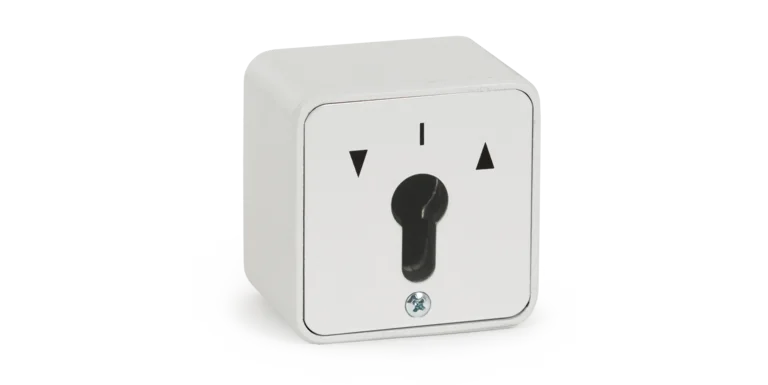
SLT 42-A surface-mounted keyed switch
The SLT 42-A provides keyed OPEN / CLOSED control through a changeover contact in a light-grey aluminium surface-mounted housing. Its IP54 enclosure measures 75 × 75 × 52 mm.
Use it where authorised-user operation and a surface-mounted enclosure are required. The PHZ 28 profile half-cylinder is selected separately.
View SLT 42-A
Key control is one part of the access strategy. Device location, key management, group assignment, labelling and override priorities must also be coordinated.
Environmental inputs
Environmental sensing
VRS 10 rain sensor
The VRS 10 monitors rainfall and provides the rain signal used by the configured control system. Its sensing area is heated and the rain signal is held for approximately two minutes.
The sensor uses a grey polycarbonate housing measuring 50 × 70 × 66 mm. The selected control panel, field wiring and operating sequence determine how connected windows or louvres respond.
A natural ventilation system still requires operating power to close its drives. Where closing during a mains failure is required, the control-panel and standby-power strategy must be selected for that function.
View VRS 10
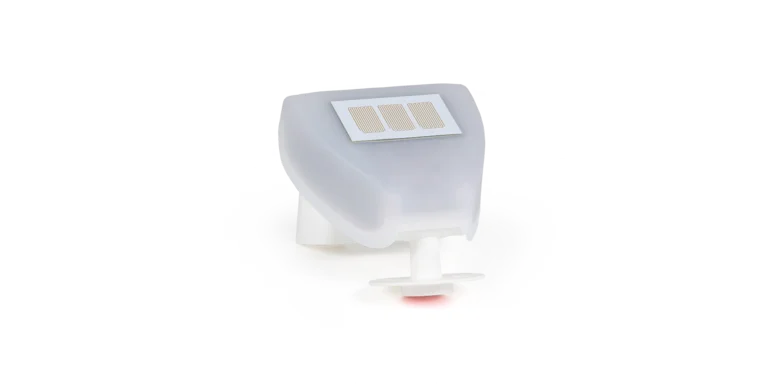
WRS-S wind and rain sensor
The WRS-S combines wind and rain monitoring in one 24 V DC weather sensor. Its wind threshold is adjustable from 1 m/s to 30 m/s, the rain-sensing area is heated and both signals are retained for approximately five minutes.
Mast and wall mounting are included. Use it where the operating sequence requires both wind- and rain-responsive control inputs.
View WRS-S
RACO2/T/F-U-D room sensor
The RACO2/T/F-U-D combines CO₂, temperature and relative-humidity sensing for natural ventilation control.
Published measuring ranges include 0–2,000 ppm or 0–5,000 ppm CO₂, 24 adjustable preset temperature ranges and 0–100% relative humidity. The white housing measures 87.5 × 87.5 × 30 mm.
Use it where the ventilation strategy needs room-condition inputs rather than manual switching alone.
View RACO2/T/F-U-D
Visual operator interface
Touchscreen operation and visualisation
TP-R2-S touch panel
The TP-R2-S provides a visual touch-control interface with project-specific programming and customised functions. It is available in 7, 10 and 15-inch formats.
The interface is suited to projects that need a central operator screen rather than individual wall switches alone. The displayed functions, user controls and system information are defined as part of the control-system design and programming scope.
View TP-R2-S
Available formats
- 7 inch — 204 × 150 × 37 mm
- 10 inch — 280 × 193 × 36 mm
- 15 inch — 398 × 298 × 47 mm
Complete system
How these devices fit into the control system
Sensors and switches are part of the complete control arrangement. They must be coordinated with the selected window drives, control panel, field cabling and operating logic.
- window or louvre drives;
- a compatible control panel or power and control arrangement;
- local switches or authorised-user controls;
- rain, room-condition or other environmental sensors;
- fire alarm, BMS or mechanical interfaces where required;
- field cabling and device terminations; and
- programming, functional testing and commissioning.
These devices do not replace the control panel or drive power supply. Their commands and signals must be received and acted on by the selected system architecture. In combined natural and smoke ventilation systems, normal ventilation and weather commands follow the approved fire-mode priority and cause-and-effect sequence.
Design information
Information required for selection
- selected control panel or power-supply arrangement;
- whether the device is 24 V DC or 230 V AC;
- required OPEN, STOP and CLOSED functions;
- number of ventilation groups and control points;
- unrestricted, key-controlled or touchscreen operation;
- required rain, CO₂, temperature or humidity response;
- device locations and user access;
- field-cable routes and termination responsibilities;
- normal operating sequence, weather response and overrides;
- commissioning, labelling and handover requirements; and
- future testing and maintenance access.
Related systems
Related systems and support
System selection
Design and delivery
Long-term support
Frequently asked questions
Frequently asked questions
What is the difference between a switch and a sensor?
A switch provides a direct user command such as OPEN, STOP or CLOSED. A sensor measures a condition such as rain, CO₂, temperature or humidity and supplies an input to the configured control system.
Which wall switch should I use?
Use LT 84-U for standard 24 V DC local operation, LT 84-U-SD where OPEN indication is required and LT 84-U-V for a compatible 230 V AC operating arrangement. Use SLT 42-U for flush-mounted key control or SLT 42-A where an IP54 surface-mounted aluminium enclosure is required. The final selection must match the controller input and field wiring.
Does a rain sensor close windows automatically?
The VRS 10 supplies a rain signal to the configured control system. The control panel, programming, connected drives and available operating power determine the closing response. Natural ventilation controls without standby power cannot operate the drives after mains power is lost.
When should WRS-S be used instead of VRS 10?
Use WRS-S where the operating sequence needs both wind and rain inputs. Use VRS 10 where rain monitoring alone is required. The selected control panel must provide compatible inputs and the programmed response for the connected drives.
Can 24 V DC and 230 V AC switches be interchanged?
No. The operating voltage, contact arrangement and connected control equipment must match the system design. The LT 84-U-V must not be substituted for a 24 V DC LT switch without reviewing the complete electrical arrangement.
When should a room sensor be used?
Use a room sensor where the natural ventilation strategy needs CO₂, temperature or humidity inputs to supplement or replace manual operation.
When is a touch panel useful?
A touch panel is useful where the project requires a central visual interface, customised functions or programmed operator controls across a wider façade or ventilation system.
Can EBSA coordinate the switches, sensors and control panel?
Yes. EBSA NZ can review the required operation, selected drives, control-panel inputs, device locations, field wiring, programming and commissioning requirements as one coordinated system.
Define the complete control arrangement with EBSA
The right switch or sensor depends on the system behind it. EBSA can confirm the device, control-panel input, wiring and programmed response before installation begins.
Catalogue information only. Contact EBSA to confirm device selection, compatibility and current availability for your project.