RZN
Established smoke and natural ventilation panels for compact and medium systems using standard group and fire-line arrangements.

Automated opening systems used in smoke ventilation, smoke relief, make-up air and smoke control strategies for New Zealand building projects.
EBSA designs, supplies and supports automated opening systems used in smoke ventilation and smoke control applications for commercial buildings across New Zealand. These systems may include automated windows, façade openings, roof openings, operable louvres, smoke ventilation control panels, fire alarm interfaces and project-specific control logic.
Smoke ventilation and smoke control systems are normally part of a wider fire safety strategy developed by the project fire engineer, mechanical engineer and design team. EBSA’s role is to support the automated opening system that may form part of that compliant solution, including product selection, control panel coordination, integration requirements and commissioning support.
Depending on the project design, automated openings may be used for smoke relief, smoke exhaust support, make-up air, stair pressurisation relief, fire alarm-controlled opening, fire-mode override or combined natural ventilation and smoke ventilation operation.
Smoke is a primary life-safety hazard in building fires. It can obscure escape routes, expose occupants to toxic gases and heat, affect firefighting access and contribute to heat build-up within the building.
Smoke ventilation and smoke control systems are used to support the fire safety strategy by managing the movement, relief or exhaust of smoke and hot gases where required by the project design. Depending on the building, this may assist occupant evacuation, support firefighting operations, provide make-up air, relieve pressure or help manage smoke spread between zones.
Automated windows, louvres and façade openings can form part of a smoke ventilation or smoke control strategy when they are correctly selected, controlled, interfaced and commissioned as part of the wider fire engineering and mechanical services design.
Smoke management is an important part of fire safety design. In New Zealand commercial buildings, smoke ventilation, smoke relief, make-up air, stair pressurisation relief or mechanical smoke control functions may be required as part of the project fire strategy, consented fire design, mechanical services design or building compliance documentation.
Automated windows, louvres and façade openings can form part of this strategy where the project design requires controlled openings to operate during a fire event or smoke control mode. The final arrangement depends on the fire engineering design, building layout, smoke control strategy, fire alarm interface, cause-and-effect matrix, mechanical services requirements, power supply, opening geometry and commissioning process.
EBSA designs, supplies and supports the automated opening system that forms part of the project’s smoke ventilation or smoke-control solution, working from the project fire strategy, mechanical design and agreed cause-and-effect requirements.
The applicable compliance pathway depends on the building type, risk group, fire strategy and consented design. Some projects may follow an Acceptable Solution pathway, while others may require a Verification Method or project-specific alternative solution supported by fire engineering.
| Reference | Typical relevance to automated smoke ventilation or smoke control openings |
|---|---|
| NZ Building Code Clause C | Primary Building Code clause area for protection from fire, including movement to a place of safety, smoke obscuration, internal fire and smoke spread, and firefighting considerations. |
| C/AS2 | Acceptable Solution for buildings other than risk group SH. It may be relevant to the project fire strategy, fire safety systems, escape routes, internal fire and smoke spread, and smoke control in air-handling systems. |
| C/VM2 | Verification Method pathway commonly associated with fire engineering analysis and project-specific fire safety design where an Acceptable Solution pathway is not used or is not sufficient. |
| AS 1668.1 | Design reference for fire and smoke control in multi-compartment buildings, including mechanical smoke control and pressurisation-related strategies where referenced by the project design pathway. |
| NZS 4512 | Relevant to fire detection and alarm systems, fire alarm interfaces, ancillary outputs, cause-and-effect coordination and control signals used to initiate smoke control operation. |
| AS/NZS 3000 | Relevant to electrical installation requirements, power supply, cabling and electrical coordination for connected control equipment. |
| Compliance schedule and BWoF requirements | Relevant where the installed system is a specified system requiring ongoing inspection, maintenance, testing and reporting to remain effective over the life of the building. |
EBSA can assist with the automated opening equipment, control-panel selection, interface coordination and commissioning support associated with the openings under our scope. The applicable compliance pathway and project design requirements are established by the relevant consultants and approval process.
A smoke ventilation or smoke control system is more than an actuator connected to a window. The system normally includes the opening element, electric drive, control panel, monitored inputs, fire-mode logic, power supply, cabling, interfaces and commissioning requirements.
Chain drives, rack and pinion drives or other suitable actuators operate compatible windows, roof openings, louvres or façade openings where selected for the project application.
Control panels manage power, inputs, outputs, battery-backed operation where required, fire-mode control and project-specific cause-and-effect requirements.
Fire alarm interfaces, mechanical services interfaces, BMS signals, manual controls, overrides, fault monitoring and commissioning procedures must be coordinated with the project design.
The required smoke control function depends on the project fire strategy and the role of each automated opening. EBSA NZ can assist with selecting and coordinating the automated opening equipment needed to support the specified function.
Opens selected windows, louvres or façade elements when required by the fire-mode sequence.
Provides controlled opening area to assist smoke relief or exhaust strategies where included in the project fire design.
Opens selected façade elements to support air replacement requirements for smoke exhaust or mechanical smoke control systems.
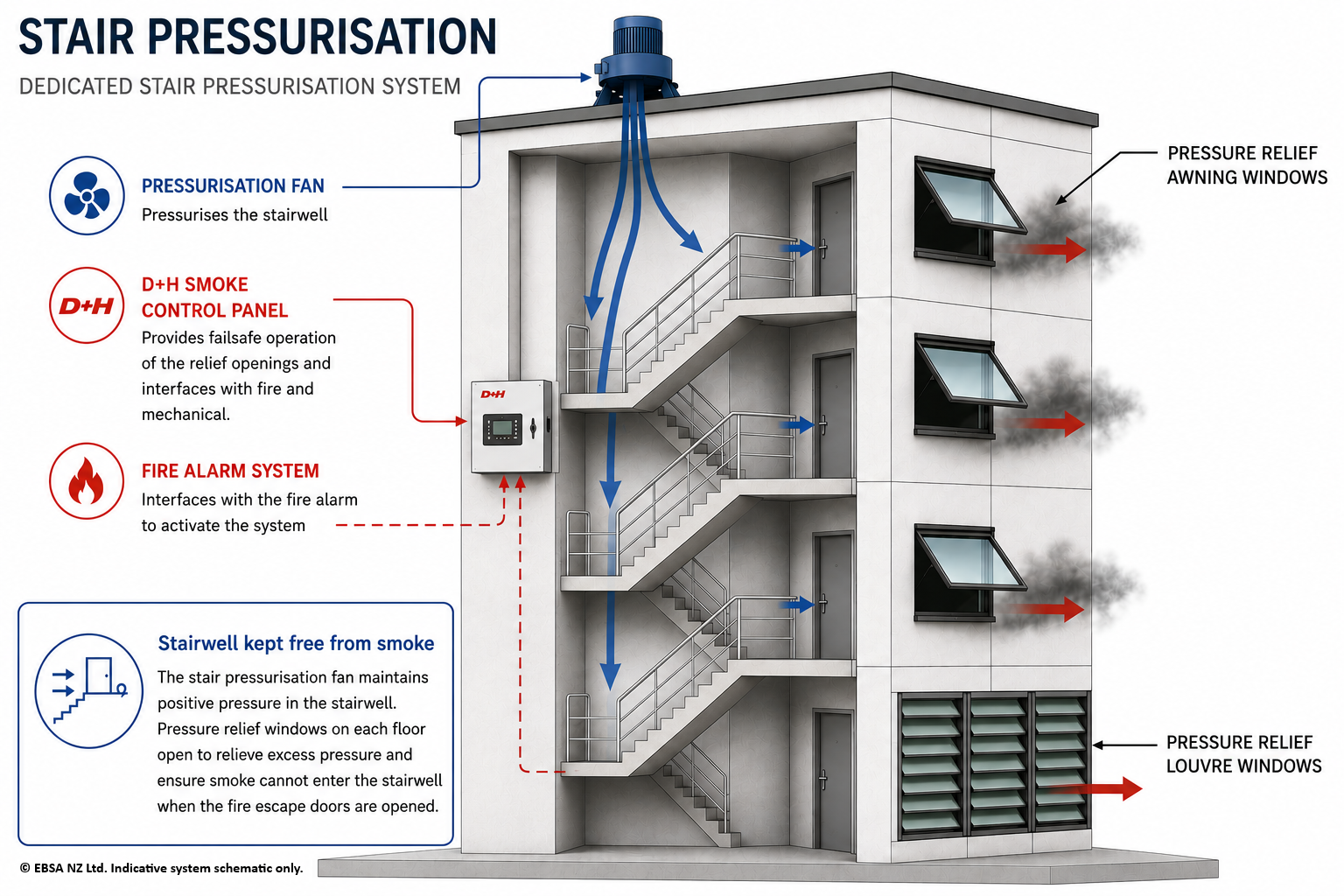
Provides controlled relief openings or make-up air openings associated with stair pressurisation or pressure control strategies where specified by the fire engineer or mechanical engineer.
Responds to fire-alarm inputs, fire-zone signals, ancillary outputs or agreed cause-and-effect logic.
Allows the same opening system to support day-to-day ventilation and fire-mode operation where the design, products and control strategy are suitable.
In stair pressurisation systems, a fan maintains positive pressure within the stairwell to help keep smoke from entering when fire escape doors are opened. Automated façade openings, including awning windows or louvre windows, may be used to relieve excess pressure where required by the fire and mechanical design.
EBSA supports the automated relief-opening system in coordination with the project fire and mechanical design, including actuator selection, control-panel operation, interfaces and commissioning requirements.
Automated smoke ventilation systems can use several types of operable building elements. The correct selection depends on the opening type, required free area, wind exposure, temperature exposure, actuator load, mounting details, façade design, access for maintenance and the requirements of the fire strategy.
Not every automated opening or natural ventilation product is suitable for smoke control use. Product suitability, actuator selection, control panel type, power supply, wiring arrangement, approval pathway and maintenance requirements should be reviewed early in the project.
The control panel is central to the smoke ventilation system. It receives the required inputs, manages power to the drives and applies the agreed fire-mode logic for each opening group and fire zone.
EBSA supplies RZN, CPS-B and CPS-P panels for defined standard arrangements, together with CPS-M modular panels for larger or project-specific systems requiring flexible zoning, programmed logic, feedback and building-system integration.
Established smoke and natural ventilation panels for compact and medium systems using standard group and fire-line arrangements.
Compact single-line, single-group panels in 2.5 A and 5 A versions for smaller smoke-control applications.
Higher-capacity 10 A, 20 A and 40 A panels for larger actuator loads, roof openings and industrial applications.
Project-specific modular panels for advanced zoning, BMS integration, ACB feedback, remote access and programmed operating sequences.
Smoke-control interfaces may include fire-alarm signals, fire-zone inputs, ancillary outputs, manual controls, smoke exhaust fans, make-up air systems, stair pressurisation systems, BMS signals, mechanical-plant interlocks, fault monitoring, test controls and maintenance controls.
The cause-and-effect sequence should be agreed by the project team, implemented within the control system and verified during commissioning.
Some buildings use the same automated windows, louvres or façade openings for both day-to-day natural ventilation and smoke control-related functions. This can be efficient, but it requires careful system design because normal ventilation operation and fire-mode operation have different priorities.
In normal mode, the system may respond to wall switches, temperature, CO2, rain, wind, time schedules or BMS inputs. In fire mode, the system may need to ignore normal ventilation commands and operate according to the fire alarm input, cause-and-effect sequence or smoke control strategy.
Where a combined system is used, EBSA can assist with actuator selection, control panel architecture, interface coordination and commissioning support. The fire-mode function should be clearly defined in the fire strategy, control matrix, electrical design and commissioning documentation.
EBSA NZ Ltd directly imports, supplies, installs and supports D+H Mechatronic window automation and control equipment in New Zealand.
D+H smoke-control panel platforms are available with certification to applicable smoke-control power-supply and control-equipment standards, including EN 12101-10 and ISO 21927-9 where stated for the selected product and configuration.
These standards address functions such as standby power, monitored power-supply behaviour, fault monitoring and protective safety features. The exact certification, enclosure and permitted system configuration are checked for the selected panel.
Product selection is coordinated with the fire strategy, opening type, required function, actuator load, field cabling, control-panel arrangement, interfaces, commissioning process and ongoing inspection requirements.
Smoke ventilation and smoke control systems should be coordinated early. The required opening area, actuator type, panel location, power supply, cabling route, fire alarm interface, manual control requirements and access for future inspection can all affect the final system design.
For New Zealand projects, EBSA can assist with reviewing:
| Product group | Typical use |
|---|---|
| Smoke Control Panels | RZN, CPS-B, CPS-P and CPS-M panels for compact, high-capacity and project-specific smoke-control systems. |
| Window Automation | Chain drives, rack drives and other actuator options for compatible windows, louvres, roof openings and façade openings. |
| Sensors and Switches | Manual controls, switches and control inputs used for operation, override, testing or system integration. |
Compare RZN, CPS-B, CPS-P and CPS-M control-panel families by capacity, configuration and typical application.
General overview of automated window systems, drives, panels, sensors and building integration.
Automated natural ventilation, mixed-mode ventilation, weather response, sensor control and project-specific ventilation logic.
Natural ventilation is used for day-to-day building operation, occupant comfort and air quality. Smoke ventilation or smoke control operation is a fire-mode function used to support the project fire strategy. Some systems use the same openings for both functions, but fire-mode operation must take priority where required by the fire strategy and cause-and-effect sequence.
Yes, where the project design, selected products, control panel architecture, wiring arrangement and approval pathway support combined operation. The normal ventilation logic and fire-mode logic should be clearly defined and tested during commissioning.
EBSA supports the automated opening system as part of the documented smoke ventilation or smoke-control strategy. This includes actuator and opening selection, control-panel design, fire and BMS interfaces, field-cabling coordination, cause-and-effect implementation and commissioning support within the agreed scope.
EBSA should be involved early by consultants and the project design team to assist with planning, confirm that the intended automated opening function is achievable, and provide practical input on implementation, coordination and buildability.
Early involvement helps confirm opening type, actuator selection, control panel requirements, power supply, field cabling strategy, fire alarm interfaces, mechanical interfaces, manual controls, access for maintenance and commissioning expectations.
For installation works, EBSA should be involved as early as possible. Fire-rated or dedicated field cabling, control panel locations, interface points and access requirements are best resolved before site works are too advanced.
Yes. EBSA NZ Ltd directly imports, supplies, installs and supports D+H Mechatronic window automation and control equipment in New Zealand. Product selection should be reviewed against the project fire strategy, opening type, required function, control panel arrangement, field cabling, interface requirements and commissioning process.
Smoke ventilation and smoke control system selection depends on the fire strategy, opening type, required function, control interfaces, power supply, commissioning requirements and ongoing maintenance obligations.
Contact EBSA early in the design or coordination process where automated windows, louvres or façade openings are intended to form part of a smoke ventilation or smoke control strategy.



© 2026 EBSA | All Rights Reserved. | Developed by Procloud
EBSA and the EBSA logo are both registered trademarks of EBSA Holdings Pty Ltd