Thermally broken construction
Thermal separation through both the perimeter frame and individual blade holders makes BT90 well suited to conditioned façades and insulated-glazing applications.

A German-manufactured, centre-pivoting operable glass louvre system with thermally broken perimeter and blade framing for double-, triple- and selected single-glazed configurations.
BT90 uses individually framed horizontal glass blades within a 90 mm thermally broken perimeter frame. Each blade pivots through its centre, providing controlled ventilation while maintaining a framed insulated-glass appearance when closed.
A heavy-duty rack-and-pinion mechanism is concealed within the side framing and can be driven by a 24 V DC actuator as part of an automated natural ventilation, BMS or smoke-control system.
EBSA supports system selection, glass and façade coordination, automation, control panels, installation options, programming, commissioning and ongoing technical support.


BT90 is a commercial operable glass louvre in which each blade is contained within its own aluminium sash and pivots horizontally within a purpose-designed perimeter frame.
Thermal breaks are incorporated into both the perimeter frame and the individual blade holders, combining operable ventilation with thermally separated framing and insulated glazing.
The heavy-duty rack-and-pinion operating mechanism is concealed within the side framing, preserving a clean architectural appearance and allowing all blades to operate together as one coordinated opening.
Thermal separation through both the perimeter frame and individual blade holders makes BT90 well suited to conditioned façades and insulated-glazing applications.
The concealed rack-and-pinion mechanism provides coordinated blade movement, positive closing and locking within the complete louvre assembly.

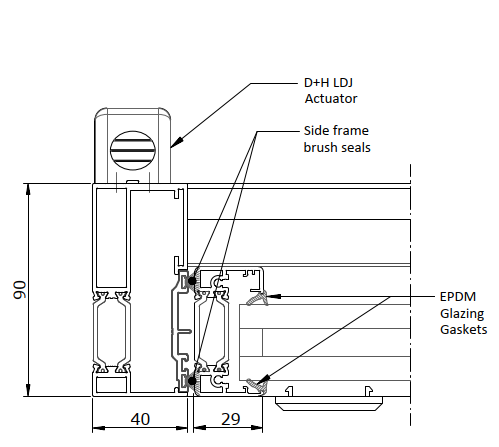
BT90 is primarily selected where a project requires insulated glazing within an operable louvre system. Glass construction is coordinated with the blade holder, louvre dimensions, design pressures, glass weight, safety requirements and wider façade glazing specification.
| BT90 configuration | Glazing accommodation | Typical application |
|---|---|---|
| BT90 IG32 | Double-glazed insulating glass units from 28–34 mm. | The standard BT90 configuration for H1 design, natural ventilation, mixed-mode ventilation and smoke-control applications. |
| BT90 IG44 | Triple-glazed insulating glass units from 40–44 mm. | Triple-glazed façade applications requiring increased insulated-glass depth. |
| Selected single glazing | Single glazing from 9.52–12.76 mm within the IG32 blade holder. | Selected façade applications where a framed single-glazed blade is appropriate. |
| Frame finish | Anodised or powder-coated aluminium profiles. | Selected to coordinate with the surrounding façade and project finish specification. |
BT90 combines thermally broken perimeter and blade framing with double- or triple-glazed insulated glass units, allowing the system to form part of conditioned façade and H1 design strategies.
Thermal performance is coordinated through the selected glass, overall louvre dimensions, frame-to-glass proportion, perimeter interfaces and installation arrangement. The selected BT90 configuration can then be incorporated into the project thermal assessment as part of the complete façade.
BT90 has been independently tested by ift Rosenheim to SNZ TS 4211:2022 using AS/NZS 4420.1:2016, including Amendment 1:2019. The full-size test programme covered serviceability, air infiltration, water penetration and ultimate strength performance.
The tested BT90 configuration measured 1500 × 2800 mm with six 1414 × 444 mm operable glass blades, a 32 mm insulated glass unit and automated 24 V DC operation with integrated locking.
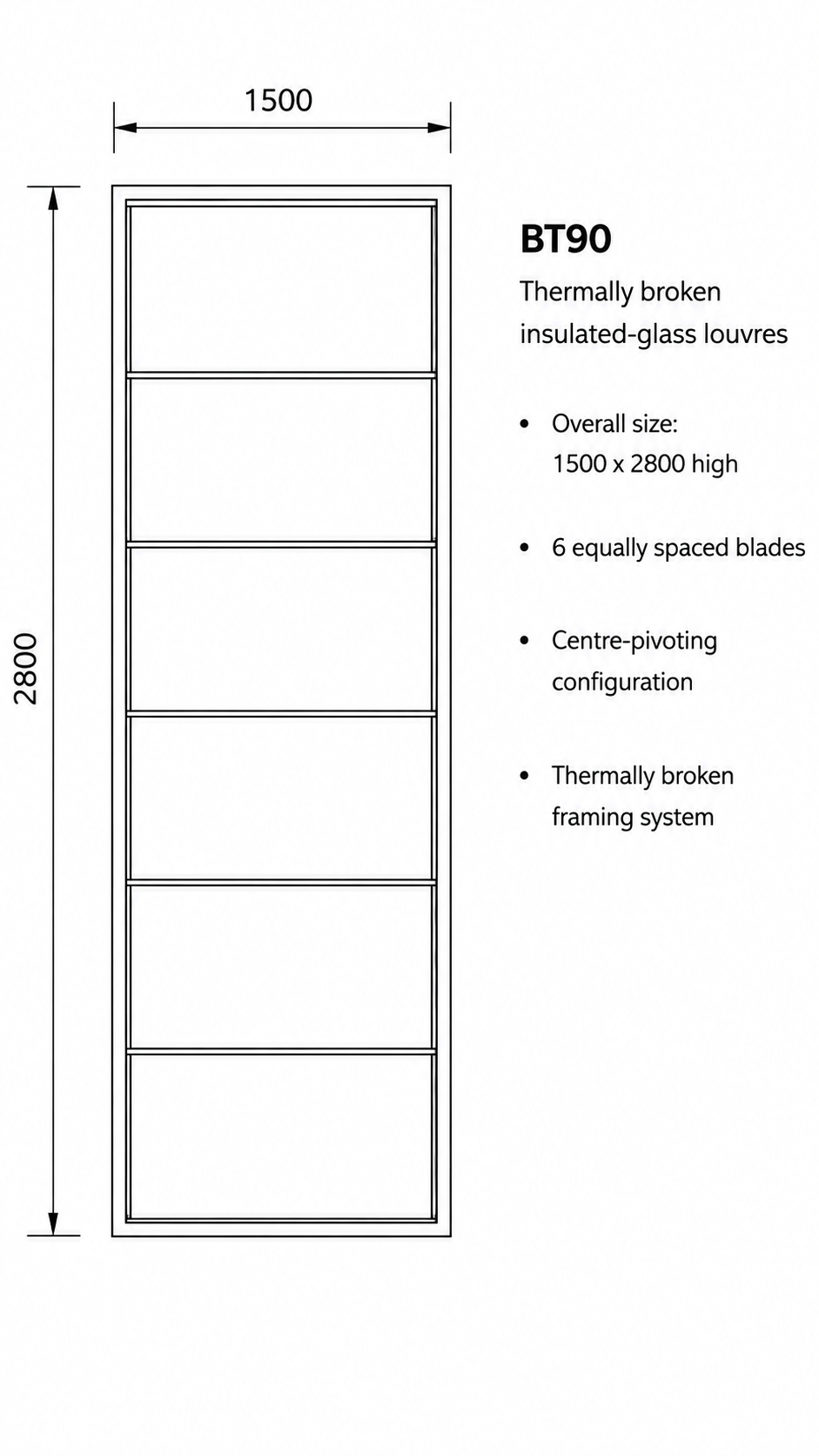
| Tested measure | Result |
|---|---|
| Tested construction | 1500 × 2800 mm overall; six 1414 × 444 mm operable casements; 32 mm IGU; 24 V DC motor with integrated locking |
| SLS | +2500 / −2500 Pa; deflection below L/250 |
| Air infiltration at 75 Pa | +0.61 / −0.65 L/s·m² |
| Air infiltration at 150 Pa | +0.99 / −1.02 L/s·m² |
| Water penetration | 650 Pa; No Water Penetration |
| ULS | +6000 / −4000 Pa; Passed |
The full-size BT90 configuration demonstrated strong façade performance, including ±2500 Pa serviceability testing, 650 Pa with no water penetration and ultimate strength testing to +6000 / −4000 Pa.
EBSA uses the independently tested BT90 configuration as the performance basis for project design, coordinating louvre dimensions, insulated-glass construction, supporting structure, frame fixing, actuator and locking forces, controls and façade interfaces with the required positive and negative project design pressures.
Operable openings combining insulated glazing with thermally broken framing as part of the wider façade and H1 design.
Automated natural ventilation coordinated with mechanical building services, temperature and carbon-dioxide sensors, weather inputs, operating schedules and BMS commands.
Schools, universities, libraries, community buildings and other commercial facilities requiring robust operable façade openings and coordinated controls.
BT90 can be integrated into systems providing pressure relief, make-up air or natural smoke exhaust, with the louvres, drives and controls coordinated with the project fire and mechanical design.
Automated operation is the primary configuration for BT90. A concealed 24 V DC drive operates the blades through the heavy-duty rack-and-pinion mechanism while the blade system provides coordinated closing and locking.
BT90 can be supplied with the D+H LDJ drive. The LDJ incorporates D+H ACB technology, enabling compatible control systems to provide real-time actuator monitoring, fault and status reporting, programming and remote technical support where the control architecture provides the required connectivity.
EBSA can coordinate the complete operating system, including control panels, local switches, environmental sensors, weather inputs, BMS interfaces, ventilation logic, fire-alarm interfaces, programming and commissioning.
BT90 is configured for the individual project. EBSA coordinates the louvre arrangement with the façade, glazing, structure, controls and installation methodology before manufacture.
BT90 can use suitable locally sourced glass. Glass may be supplied through the wider façade or glazing package or included within EBSA’s project scope.
Coordinating the louvre glass with the wider glazing package can align glass colour, coating and appearance across the building. EBSA provides the required blade-holder and glazing information and coordinates the proposed glass with the complete BT90 configuration.
EBSA can be engaged for product supply, supported façade delivery, defined installation scope or a complete turnkey BT90 package.
| Delivery pathway | Typical EBSA role |
|---|---|
| Product supply | Project-configured BT90 system together with agreed product, installation and coordination information. |
| Supported façade delivery | Technical coordination with the builder, façade contractor, aluminium joiner or glazier on openings, glass, structure, installation, drives and control requirements. |
| Supply and installation | Louvre supply and installation, including glazing where included within the agreed EBSA scope. |
| Turnkey package | Design coordination, louvre supply, glazing coordination, installation, field cabling where included, control panels, programming, commissioning, handover and ongoing support. |
Completed BT90 installations demonstrate the system across commercial, education and civic façade applications.

Framed BT90 operable glass louvres integrated into the building’s glazed external envelope.

BT90 openings incorporated into an education façade and coordinated natural-ventilation system.

Thermally broken framed glass louvres coordinated with the architectural façade and ventilation requirements.
BT90 systems are manufactured in Germany to the approved project configuration. The programme should allow for design coordination, glass confirmation, production information, approvals, manufacture, international freight and local delivery.
BT90 is manufactured in Germany by Schneider Louvres. EBSA provides system selection, technical coordination, supply, automation, installation options, programming, commissioning and ongoing support for the system.
BT90 thermally broken operable glass louvre systems supplied and supported by EBSA.
| System | Glazing and operation | Typical selection reason |
|---|---|---|
| BT90 | Thermally broken, centre-pivoting framed double- or triple-glazed blades. | Insulated glazing within a clearly framed, thermally separated louvre system. |
| MP2 SGI | Thermally broken, end-pivoting double- or triple-glazed blades with a structurally glazed external appearance. | Insulated glazing combined with a clean external glass expression. |
| LF550 | Large-format point-fixed single-glazed, end-pivoting blades. | A lighter, highly transparent louvre construction where insulated glazing is not required. |
Thermal breaks are incorporated into both the 90 mm perimeter frame and the individual aluminium blade holders, providing thermal separation through the complete framed louvre system.
BT90 IG32 accepts double-glazed insulating glass units from 28–34 mm. BT90 IG44 accepts triple-glazed units from 40–44 mm. Selected single glazing from 9.52–12.76 mm can also be accommodated within the IG32 blade holder.
Yes. BT90 has been independently tested by ift Rosenheim to SNZ TS 4211:2022 using AS/NZS 4420.1:2016 procedures. The full-size 1500 × 2800 mm configuration was tested for serviceability, air infiltration, water penetration and ultimate strength.
The 1500 × 2800 mm BT90 configuration achieved serviceability testing to ±2500 Pa with deflection below L/250 and passed ultimate strength testing at +6000 / −4000 Pa.
The full-size 1500 × 2800 mm BT90 configuration achieved No Water Penetration at 650 Pa during independent ift Rosenheim testing.
BT90 dimensions are configured around the proposed glazing, glass weight, positive and negative design pressures, blade arrangement, frame fixing and supporting structure. EBSA uses the independently tested 1500 × 2800 mm configuration as the performance basis when coordinating project-specific systems.
BT90 combines thermally broken perimeter and blade framing with double- or triple-glazed insulated glass units. The selected glass and louvre configuration can be incorporated into the project thermal assessment as part of the complete façade.
The D+H LDJ is a concealed 24 V DC drive developed for the BT90 operating mechanism. With D+H ACB technology and a compatible control system, it can provide actuator communication, status monitoring, fault reporting, programming and remote technical support.
Yes. BT90 can form part of a mixed-mode ventilation strategy combining automated natural ventilation with mechanical building services. The system can be coordinated with temperature, carbon-dioxide, rain and wind sensors, schedules, local controls and BMS commands.
Yes. Suitable locally sourced glass can be coordinated with BT90, allowing colour, coatings and appearance to align with the wider project glazing package.
Manual operation is available for selected applications. BT90 is primarily suited to automated operation where the louvres form part of natural ventilation, BMS or smoke-control systems.
Yes. BT90 can be integrated into smoke-control systems for functions including pressure relief, make-up air and natural smoke exhaust. EBSA coordinates the louvre, drive, control system and project interfaces with the fire and mechanical design.
BT90 aluminium profiles can be anodised or powder coated to coordinate with the surrounding façade and project finish specification.
BT90 is best considered during façade design development so the louvre dimensions, glass, project pressures, supporting structure, drives, controls, façade interfaces and procurement programme can be coordinated before manufacture.
Contact EBSA to review the proposed opening size, glazing, façade interfaces, design pressures, automation requirements and project delivery strategy.



© 2026 EBSA | All Rights Reserved. | Developed by Procloud
EBSA and the EBSA logo are both registered trademarks of EBSA Holdings Pty Ltd